
Introduction
Design is one of the most powerful tools in branding and marketing, but not all design works in the same way. Many people believe that a design created for social media or a website can also be used directly for printing. This assumption often leads to poor quality results, incorrect colors, and wasted marketing budgets.
The reality is that print design and digital design are built on completely different technical foundations. They differ in how colors are created, how resolution is handled, how files are prepared, and even how the final output is viewed by the audience.
Understanding these differences is important for any business that wants to maintain a strong and consistent brand identity across both online and offline platforms.
What is Print Design?
Print design refers to any visual content that is created for physical output. This includes items such as business cards, brochures, flyers, packaging, banners, posters, and books. The final design is printed on paper or other materials and physically distributed to customers.
Because print design is physical, it requires extreme precision. Every detail matters, from color accuracy to image sharpness and layout alignment. Once something is printed, it cannot be changed, which means the design must be prepared correctly from the beginning.
In professional printing workflows, print design always follows strict technical standards to ensure that the final output matches what the designer intended.
What is Digital Design?
Digital design is created specifically for screens such as smartphones, computers, tablets, and digital displays. It includes website design, mobile apps, social media posts, banners, and online advertisements.
Unlike print design, digital design is flexible and interactive. It can include animations, clickable elements, scrolling effects, and responsive layouts that adjust according to screen size.
Digital design focuses more on user experience, performance, and adaptability rather than physical accuracy.
Key Differences Between Print Design and Digital Design
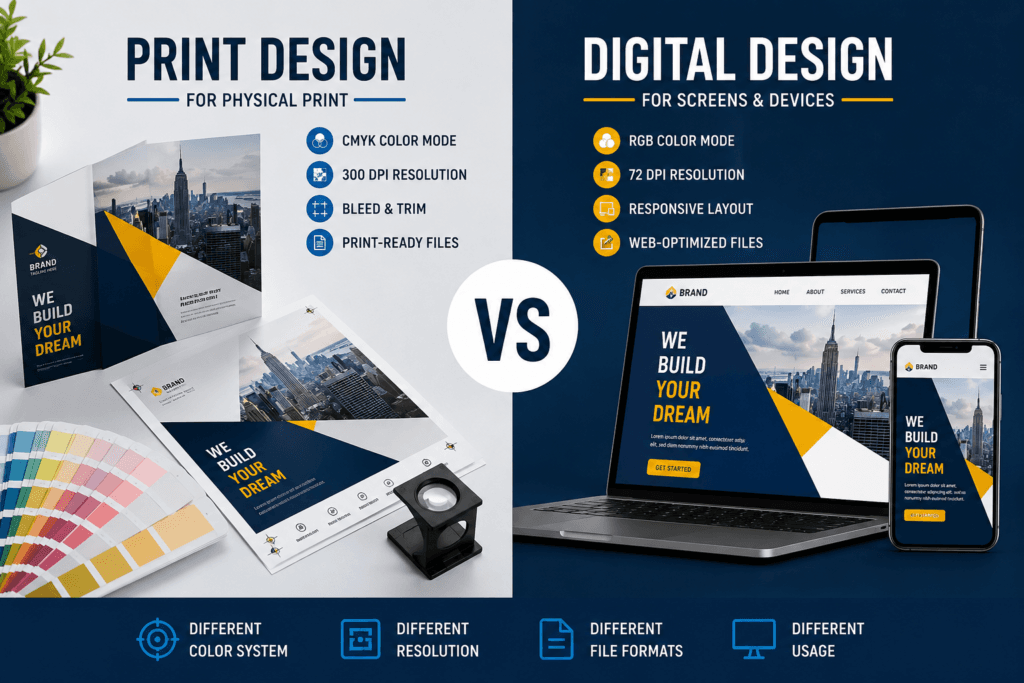
One of the biggest differences between print and digital design is the color system. Print design uses the CMYK color model, which stands for Cyan, Magenta, Yellow, and Black. These colors are physically mixed using ink during printing. Digital design, on the other hand, uses the RGB color model, which stands for Red, Green, and Blue. These colors are created using light on screens.
Because of this difference, a design that looks bright on a screen may appear dull when printed if it is not converted properly from RGB to CMYK. This is one of the most common issues businesses face when they use digital files for printing without adjustments.
Another major difference is resolution. Print design requires high resolution, typically 300 DPI, to ensure that the final printed output is sharp and clear. Digital design usually works with lower resolution because screens display images differently and do not require the same level of detail.
File formats also play a key role in separating both design types. Print design commonly uses PDF, AI, EPS, and TIFF formats because they preserve high quality and are compatible with printing machines. Digital design relies more on JPG, PNG, SVG, and GIF formats because they are optimized for web performance and loading speed.
Layout, Bleed, and Physical Accuracy
Print design must account for physical cutting and trimming processes. This is why designers include a bleed area, which is extra space outside the final design boundary. This ensures that no unwanted white edges appear after the paper is cut.
Digital design does not require bleed because there is no physical cutting involved. Instead, it focuses on screen layout, responsiveness, and alignment across different devices.
Typography also behaves differently in both formats. In print design, fonts must be embedded into the file to ensure consistency during printing. Even small spacing issues can affect readability on paper. In digital design, fonts are loaded through systems or web services and can adjust dynamically depending on screen size.
Interactivity and User Experience
Digital design is interactive, which is one of its biggest advantages. Users can click buttons, scroll through pages, hover over elements, and interact with animations. This creates a dynamic experience that helps improve engagement and conversion rates.
Print design is completely static. Once printed, it remains fixed and cannot change. Its purpose is to deliver information visually and physically rather than interactively.
Because of this difference, digital design focuses heavily on user experience and usability, while print design focuses on clarity, accuracy, and visual impact.
Viewing Environment Differences
Print design is viewed in real-world lighting conditions. This means colors may look slightly different depending on sunlight, indoor lighting, or paper texture. Designers must consider how the final printed material will appear in physical environments.
Digital design is viewed on screens, where brightness, contrast, and resolution can vary from device to device. A design may look different on a mobile phone compared to a large monitor.
This is why designers often test digital designs across multiple devices, while print designers rely on standardized printing settings.
Why Businesses Must Understand This Difference
Many businesses make the mistake of using the same design for both print and digital platforms without any modification. This leads to poor results such as blurry prints, incorrect branding colors, and unprofessional appearance.
When businesses understand the difference between print and digital design, they can ensure consistency in branding, better customer perception, and higher marketing effectiveness.
A properly designed print material creates a strong first impression, while a well-optimized digital design improves online engagement. When both are used correctly together, they create a powerful and consistent brand presence.
How Print and Digital Design Work Together
Although they are different, print and digital design are not competitors. In fact, they work best when used together as part of a complete marketing strategy.
For example, a customer may first see a brand through a social media advertisement, which is digital design. Later, they might receive a brochure or business card, which is print design. This combination strengthens brand recall and builds trust.
Businesses that integrate both forms of design usually achieve better marketing results because they engage customers across multiple touchpoints.
Conclusion
Print design and digital design are two completely different systems that serve different purposes. Print design focuses on physical accuracy, color precision, and high-resolution output, while digital design focuses on interactivity, flexibility, and screen optimization.
Businesses that understand and apply both correctly can maintain a strong and consistent brand presence across all marketing channels. Instead of replacing each other, print and digital design work best when used together as part of a unified branding strategy.
FAQs
1. What is the main difference between print design and digital design?
Print design is created for physical materials like paper and packaging, while digital design is made for screens such as websites and social media. Both use different color systems, resolution, and file formats.
2. Why does print design use CMYK instead of RGB?
Print design uses CMYK because printers mix ink physically using Cyan, Magenta, Yellow, and Black. RGB is used for screens because it works with light, not ink.
3. What resolution is best for print design?
The standard resolution for print design is 300 DPI. This ensures that images and text appear sharp and clear when printed on physical materials.
4. Can I use the same design for print and digital?
Not directly. A design must be adjusted for color mode, resolution, and layout before it is used in printing. Otherwise, the quality may decrease or colors may look different.
5. What file format is best for printing?
PDF is the most commonly used file format for printing because it maintains high quality and keeps all design elements intact. AI, EPS, and TIFF are also widely used.